

Lighting Measurements – An In-depth Guide Part 1
When retrofitting your LEDs, lightbulbs have various illuminance. Theres different ways to measure the lighting of…

This blog was originally published June 14, 2022, and has been updated July 28, 2026.
Choosing the right LED flat panel is about more than appearance. While both back-lit and edge-lit LED panels deliver energy-efficient, uniform lighting, their internal designs affect efficiency, thermal management, fixture depth, maintenance requirements, and long-term performance. Understanding these differences can help facility managers, building owners, and lighting designers select the best solution for their application.
If you’re wondering what the difference is between back-lit and edge-lit LED panels, which LED panel lasts longer, or which option is best for your facility, this guide breaks down how each technology works, compares their advantages, and explains when one may be a better fit than the other.
| Feature | Back-Lit LED Panels | Edge-Lit LED Panels |
| LED Placement | LEDs mounted directly behind diffuser | LEDs mounted around fixture perimeter |
| Light Distribution | Direct illumination | Light guided through an internal light guide plate (LGP) |
| Fixture Depth | Slightly deeper | Ultra-thin profile |
| Thermal Management | Excellent | Good |
| Efficiency | Typically higher | Typically slightly lower |
| Uniformity | Excellent with quality optics | Excellent when LGP is well designed |
| Lifespan | Often longer due to improved heat dissipation | Long lifespan with proper thermal design |
| Best Applications | High-use commercial facilities | Modern offices and architectural interiors |
Back-lit LED panels position the LED chips directly behind the diffuser rather than around the perimeter of the fixture. The LEDs are mounted to a metal core printed circuit board (MCPCB), which helps transfer heat away from the light source. As light is emitted, a reflective back panel redirects any stray light forward while the diffuser spreads illumination evenly across the fixture.
Because the light travels directly from the LEDs through the diffuser, back-lit panels require fewer optical components than edge-lit designs. This simplified construction reduces internal light loss and creates a straightforward optical system.
Back-lit panels are frequently selected for facilities where lighting operates for long hours each day, including healthcare facilities, educational institutions, warehouses, and commercial office buildings.
Edge-lit LED panels place the LEDs along the perimeter of the fixture instead of behind the diffuser. The light enters a transparent Light Guide Plate (LGP), where precision laser-etched or printed micro-patterns distribute it evenly across the entire surface before it passes through the diffuser.
This optical design allows manufacturers to produce extremely thin fixtures while maintaining consistent illumination across the panel. Because the LGP performs most of the light distribution, edge-lit panels can achieve a sleek architectural appearance without increasing fixture depth.
Advantages of Edge-Lit LED Panels
Edge-lit panels are commonly installed in corporate offices, conference rooms, educational spaces, reception areas, and commercial interiors where aesthetics are an important consideration.
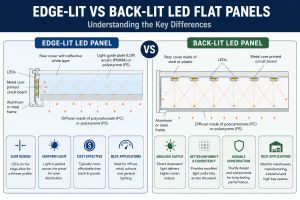
Although both technologies deliver uniform, energy-efficient lighting, their different designs influence performance, installation, maintenance, and long-term value.
Back-lit panels generally dissipate heat more effectively because the LEDs are mounted behind the diffuser with more internal air space. Better thermal management can improve lumen maintenance and extend the life of LED components and drivers.
Edge-lit panels have a more compact design that limits airflow compared to most back-lit fixtures. While high-quality edge-lit panels are engineered to manage heat effectively, thermal performance varies more depending on fixture quality.
If minimizing fixture depth is a priority, edge-lit panels have the advantage. Their use of a Light Guide Plate allows manufacturers to produce exceptionally thin fixtures, making them well suited for shallow ceiling plenums and modern architectural applications.
Back-lit panels require additional depth to accommodate the LED array behind the diffuser, resulting in a slightly thicker fixture.
Because back-lit panels direct light through fewer optical components, they often experience less internal light loss. Many commercial back-lit fixtures achieve slightly higher efficacy, although both technologies offer significant energy savings compared to fluorescent troffers.
Both panel types require minimal maintenance compared to fluorescent lighting, but back-lit fixtures often benefit from improved thermal performance during years of continuous operation. High-quality edge-lit panels can provide comparable service life when manufactured with premium components and proper optical design.
Not necessarily.
The better option depends on your facility’s goals, operating conditions, and lighting priorities.
Back-lit panels often provide advantages when long operating hours, energy efficiency, and long-term durability are the highest priorities. Their simplified optical design and improved thermal management can contribute to strong performance over many years.
Edge-lit panels excel when a thin architectural profile, modern aesthetics, and installation flexibility are more important considerations.
Rather than asking which technology is universally better, facility managers should evaluate which fixture best aligns with the project’s performance requirements, ceiling conditions, budget, and visual goals.
The answer depends on fixture quality, driver performance, operating conditions, and thermal management.
In many applications, quality back-lit LED panels may maintain their performance longer because the LEDs operate at lower temperatures. Reduced heat helps preserve lumen output and extends the life of both the LEDs and driver components.
However, high-quality edge-lit panels designed with effective thermal management and premium optical materials can also deliver service lives exceeding 50,000 hours.
Regardless of technology, selecting commercial-grade fixtures from reputable manufacturers and following proper installation practices are the biggest factors influencing long-term performance.

The right choice depends on the needs of your facility.
| Facility Type | Recommended Panel Type |
| Corporate Offices | Edge-Lit or Back-Lit |
| Healthcare | Back-Lit |
| Schools & Universities | Back-Lit |
| Government Buildings | Back-Lit |
| Retail Stores | Either, depending on design goals |
| Hospitality | Edge-Lit |
| Conference Rooms | Edge-Lit |
| Administrative Buildings | Either |
When evaluating lighting upgrades, purchase price should only be one part of the decision.
Facility managers should also consider total cost of ownership, including:
A fixture with a slightly higher initial investment may deliver greater long-term savings through lower energy use, fewer maintenance visits, and longer service life.
For facilities operating lighting 10 to 16 hours per day, or even around the clock, these savings can become significant over the life of the system.
Read our guide to Commercial Lighting Design Trends for 2026 to learn how advances in LED technology, smart controls, human-centric lighting, and sustainable design are shaping modern commercial facilities. Then discover how Action Services Group can help you design and implement a lighting system built for the future.
👉 Read Commercial Lighting Design Trends for 2026
Before choosing between back-lit and edge-lit panels, evaluate:
Working with an experienced commercial lighting partner can help ensure the selected fixtures meet both performance expectations and long-term operational goals.
Can back-lit and edge-lit LED panels replace fluorescent troffers?
Yes. Both back-lit and edge-lit LED panels are designed to replace traditional fluorescent troffers in standard ceiling grids. They provide improved energy efficiency, longer lifespans, lower maintenance requirements, and more consistent light quality.
Are back-lit LED panels more energy efficient than edge-lit panels?
Both technologies are highly energy efficient, but back-lit LED panels often achieve slightly higher efficacy because light travels through fewer optical components. Actual energy savings depend on the fixture’s design, driver quality, and lumens-per-watt (lm/W) rating.
Can edge-lit LED panels turn yellow over time?
Lower-quality edge-lit panels that use polystyrene (PS) light guide plates may yellow after prolonged exposure to heat and UV light, which can affect light quality. Higher-quality fixtures use polymethyl methacrylate (PMMA) light guide plates, which offer better optical stability and resist yellowing over time.
What should I look for when comparing commercial LED flat panels?
Compare more than just price. Evaluate fixture efficacy (lm/W), driver quality, warranty, color rendering (CRI), lumen maintenance, thermal management, compatibility with lighting controls, and the quality of optical components. These factors have a greater impact on long-term performance than the initial purchase price alone.
Can LED flat panels be used with lighting controls?
Yes. Many commercial LED flat panels are compatible with occupancy sensors, daylight harvesting, dimming systems, and networked lighting controls (NLCs). Pairing LED panels with lighting controls can further reduce energy consumption and improve building efficiency.
Whether you’re replacing outdated fluorescent troffers, planning a commercial renovation, or designing a new facility, selecting the right LED panel can improve lighting quality, reduce energy consumption, and lower long-term maintenance costs. Both back-lit and edge-lit LED panels offer significant advantages over legacy lighting systems, but the best choice depends on your facility’s operating hours, performance requirements, ceiling conditions, and design goals.
Action Services Group helps organizations simplify commercial lighting upgrades with turnkey lighting solutions, including lighting design, product selection, installation, maintenance, lighting controls, energy rebate management, and ongoing support. Our experienced team can evaluate your facility, recommend the right LED panel solution, and deliver a lighting system that maximizes efficiency, reliability, and long-term value. Contact our experts by calling 610-558-9773, email [email protected], or schedule a call directly through our website.
When retrofitting your LEDs, lightbulbs have various illuminance. Theres different ways to measure the lighting of…
Understanding light measurements, luminance and foot-candle can help when choosing the perfect bulb for you next…
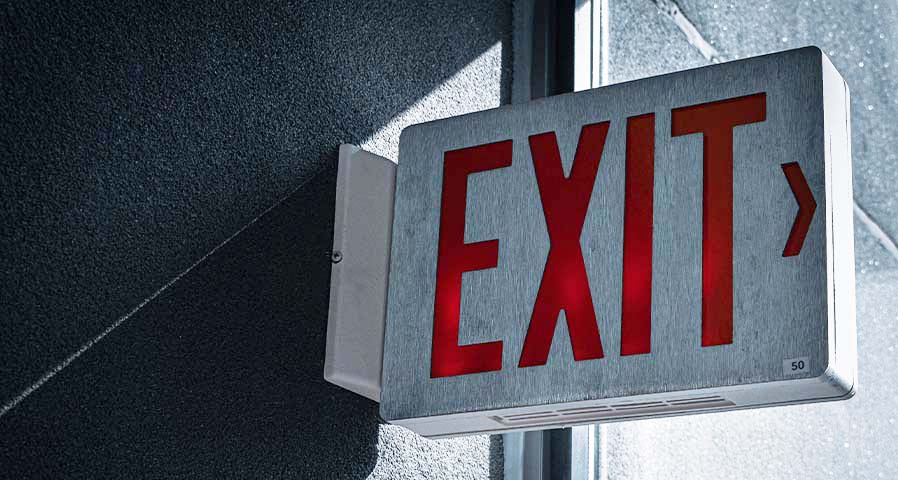
Exit signs and emergency lighting need to be in accordance with the NFPA, OSHA, and other…
When retrofitting your LEDs, lightbulbs have various illuminance. Theres different ways to measure the lighting of your next retrofit.
Understanding light measurements, luminance and foot-candle can help when choosing the perfect bulb for you next retrofit.
Exit signs and emergency lighting need to be in accordance with the NFPA, OSHA, and other state or local ordinances.