

Lighting Measurements – An In-depth Guide Part 1
When retrofitting your LEDs, lightbulbs have various illuminance. Theres different ways to measure the lighting of…


Modern smart buildings rely on constant communication between HVAC systems, lighting controls, access control systems, meters, sensors, and other connected devices. Building automation protocols enable communication between systems and manufacturers by allowing them to exchange data across a shared network.
When discussing building automation protocols, three names continue to dominate the conversation: BACnet, Modbus, and LonWorks. While all three protocols support communication between devices, they differ significantly in architecture, scalability, interoperability, integration complexity, and long-term viability.
Understanding the differences between BACnet, Modbus, and LonWorks helps facility managers, system integrators, and building owners choose the right protocol for both new construction and retrofit projects.
Building automation protocols determine how devices communicate across HVAC, lighting, energy management, and security systems. While BACnet, Modbus, and LonWorks all support automation, they serve different purposes and offer different levels of scalability and interoperability.
What are the biggest differences between BACnet, Modbus, and LonWorks?
Building automation protocols are communication standards that allow devices and systems to exchange information within a Building Automation System (BAS) or Building Management System (BMS).
These protocols help systems coordinate operations such as:
Without standardized protocols, every manufacturer would operate within a closed ecosystem, making integration difficult and expensive.
ASHRAE developed BACnet in the 1990s specifically for building automation applications. BACnet is now recognized internationally under ISO 16484-5 and has become the dominant open protocol for commercial building automation.
BACnet supports communication between:
One of BACnet’s biggest advantages is its semantic data model. Data points are self-descriptive, meaning devices can identify whether a value represents temperature, humidity, airflow, occupancy, or another function without requiring extensive manual interpretation.
This dramatically reduces integration complexity in large smart building projects.

Schneider Electric originally introduced Modbus in 1979 through Modicon PLC systems. Modbus quickly became one of the most widely used industrial automation protocols because of its simplicity and universal compatibility.
Modbus is commonly used for:
Unlike BACnet, Modbus does not include semantic meaning within its registers. Each register must be manually mapped using the manufacturer’s documentation.
For example, one register may represent temperature, while another could represent voltage or fan speed. Integrators must manually decode these values during commissioning.
Echelon Corporation created LonWorks as a peer-to-peer networking protocol for automation systems.
LonWorks became popular in the 1990s and early 2000s for:
Unlike traditional master-slave architecture, LonWorks allows devices to communicate directly with one another across the network.
Although innovative at the time, LonWorks has steadily lost ground as BACnet became the preferred open standard for modern smart buildings.
| Feature | BACnet | Modbus | LonWorks |
| Primary Market | Building automation | Industrial automation | Legacy building automation |
| Architecture | Client-server and IP-based | Master-slave | Peer-to-peer |
| Interoperability | High | Moderate | Limited |
| Semantic Data Modeling | Yes | No | Partial |
| Scalability | High | Moderate | Moderate |
| Open Standard | Yes | Mostly open | Partially proprietary |
| Common Uses | HVAC, lighting, BAS | Meters, PLCs, industrial controls | Legacy lighting and automation |
| Integration Complexity | Lower | Higher | Moderate |
| Long-Term Market Growth | Strong | Stable | Declining |
BACnet simplifies building automation by enabling devices to communicate using standardized object types and naming conventions.
For example, a BACnet temperature sensor automatically identifies itself as a temperature object. Integrators do not need to interpret raw data values manually.
This standardized ontology improves:
BACnet also supports both BACnet/IP and BACnet MS/TP networks, allowing buildings to scale from smaller serial networks to enterprise-wide IP infrastructures.
Even though BACnet dominates modern BAS deployments, Modbus remains extremely common because many industrial devices still rely on it.
Common Modbus-connected devices include:
Many modern BAS platforms integrate Modbus devices through gateways or protocol converters.
Modbus remains valuable because it is:
However, Modbus becomes harder to manage as systems grow larger and more complex.
Continue Your Building Automation Learning Journey
Understanding BACnet, Modbus, and LonWorks is an important step toward designing a smarter, more connected building. To deepen your knowledge of lighting controls, building automation, and smart facility technologies, explore our Lighting Controls Blog Feed for additional educational resources and industry insights.
Then, visit our Lighting Control Solutions page to learn how Action Services Group helps organizations implement intelligent control systems that improve efficiency, visibility, and operational performance.
When you’re ready, schedule a call with our lighting controls specialists to discuss your facility, integration goals, and next steps.
👉 Explore the Lighting Controls Blog Feed
👉 Learn About Lighting Control Solutions
👉 Schedule a Call with Our Lighting Controls Specialists
LonWorks introduced several advanced networking concepts early in the evolution of building automation, especially peer-to-peer communication.
However, several factors limited long-term adoption:
Today, LonWorks primarily exists in legacy infrastructures where replacing the existing network would be too expensive or disruptive.
For most modern smart building projects, BACnet has become the preferred protocol because it combines:
BACnet also aligns well with modern building technologies, including:
Modbus still plays an important role in industrial integration, while LonWorks continues to support older infrastructures.
BACnet now dominates commercial smart buildings, while Modbus remains heavily used in industrial environments and equipment integration. LonWorks continues to operate mainly in legacy infrastructures.
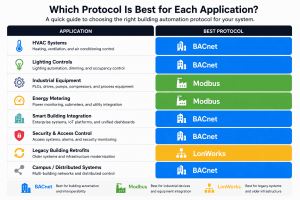
Modern lighting controls and energy management systems increasingly depend on open communication protocols for interoperability and analytics.
BACnet is commonly used in:
Modbus often supports:
As buildings become more connected, protocol interoperability becomes increasingly important for integrating lighting, HVAC, security, and energy systems into a unified smart building platform.
Is BACnet better than Modbus?
BACnet is generally better for large building automation systems because it provides standardized semantic data modeling and stronger interoperability. Modbus works well for simple industrial device communication and legacy integrations.
Is Modbus still used in commercial buildings?
Yes. Modbus remains extremely common for connecting industrial equipment, meters, generators, and PLC systems within commercial facilities.
Is LonWorks obsolete?
LonWorks is not completely obsolete, but its adoption has declined significantly. Most new smart building projects now favor BACnet due to broader interoperability and stronger vendor support.
Can BACnet and Modbus work together?
Yes. Many building automation systems use gateways or controllers that integrate both BACnet and Modbus devices within the same infrastructure.
Why is BACnet popular in smart buildings?
BACnet simplifies integration, supports IP networking, improves interoperability, and reduces commissioning complexity for large-scale building automation systems.
Choosing between BACnet, Modbus, and LonWorks depends on the goals of the building automation project, the existing infrastructure, and the required level of interoperability.
Modbus continues to perform well in industrial environments and in legacy equipment integrations due to its simplicity and widespread support. LonWorks still exists within older infrastructures but has steadily lost market share in modern automation projects.
BACnet has emerged as the dominant protocol for smart buildings because it was specifically designed for building automation. Its open architecture, semantic data structure, scalability, and interoperability make it ideal for modern HVAC systems, lighting controls, energy management platforms, and connected IoT environments. As smart building technology continues evolving, BACnet will likely remain the foundation for future-ready building automation systems that prioritize efficiency, integration, and long-term scalability.
Action Services Group can guide you through the process of implementing smart technology into your building and choosing the right protocols that suit your needs. To learn more, call 610-558-9773, email [email protected], or schedule a consultation that works for you.

When retrofitting your LEDs, lightbulbs have various illuminance. Theres different ways to measure the lighting of…

Understanding light measurements, luminance and foot-candle can help when choosing the perfect bulb for you next…

Exit signs and emergency lighting need to be in accordance with the NFPA, OSHA, and other…
When retrofitting your LEDs, lightbulbs have various illuminance. Theres different ways to measure the lighting of your next retrofit.
Understanding light measurements, luminance and foot-candle can help when choosing the perfect bulb for you next retrofit.
Exit signs and emergency lighting need to be in accordance with the NFPA, OSHA, and other state or local ordinances.