

Lighting Measurements – An In-depth Guide Part 1
When retrofitting your LEDs, lightbulbs have various illuminance. Theres different ways to measure the lighting of…


This blog was originally published November 10, 2020 and has been updated August 11, 2026.
Lighting energy savings are only part of the financial value of an LED retrofit. Because LEDs produce significantly less waste heat than traditional lighting systems, they also reduce the amount of heat your HVAC system must remove during cooling season. Including these indirect energy savings provides a more accurate estimate of total operating cost reductions and project payback.
This article builds on Calculating Your Lighting-Only Energy Savings. Complete those calculations first, then use the steps below to estimate your HVAC savings before moving on to Calculating Your Maintenance Savings part 1 and part 2
Traditional lighting systems convert a significant portion of electricity into heat rather than visible light. That heat becomes part of a building’s internal cooling load, forcing air-conditioning systems to work harder during cooling season.
LED lighting operates much more efficiently, reducing internal heat gains and lowering the amount of energy required for cooling. ASHRAE’s building energy guidance and the U.S. Department of Energy both recognize lighting as one of the primary internal heat sources that influence commercial HVAC loads. Lower lighting heat gains translate into lower cooling energy consumption in air-conditioned buildings.
The largest HVAC savings are typically realized in facilities with:
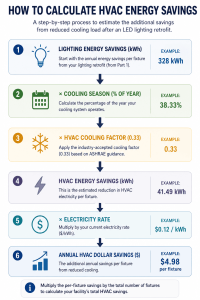
Gather the following information before starting your calculations.
| Information | Example |
| Annual lighting energy savings per fixture | 328 kWh |
| Months cooling system operates | 4.6 months |
| Electricity rate | $0.12 per kWh |
| HVAC cooling adjustment factor | 0.33 |
For consistency, this example uses the 328 kWh annual lighting savings per fixture calculated in Part 1 of this series.
The commonly used 0.33 cooling adjustment factor is derived from ASHRAE building energy modeling practices that account for the interaction between lighting loads and mechanical cooling. Actual savings vary by building type, climate, and HVAC system design.
First, determine how much of the year your building requires air conditioning.
Cooling Percentage = Months of Cooling ÷ 12
Example
4.6 ÷ 12 = 38.33%
In this example, the cooling system operates for approximately 38.33% of the year.
Estimate the reduction in HVAC electricity by applying the cooling adjustment factor.
HVAC Energy Savings (kWh) = Lighting Energy Savings × Cooling Percentage × 0.33
Example
328 × 38.33% × 0.33 = 41.49 kWh
Each LED fixture reduces HVAC electricity consumption by approximately 41.49 kWh annually.
Multiply the HVAC energy savings by your electricity rate.
Annual HVAC Savings ($) = HVAC Energy Savings × Electricity Rate
Example
41.49 × $0.12 = $4.98 per fixture annually
While the savings from one fixture appear small, they scale quickly across an entire facility.
| Number of Fixtures | Annual HVAC Savings |
| 100 | $498 |
| 250 | $1,245 |
| 500 | $2,490 |
| 1,000 | $4,980 |
These savings are in addition to the direct lighting energy savings calculated in Part 1.
Explore Interconnected Building Automation in 2026
Building automation systems (BAS) connect lighting, HVAC, occupancy sensors, scheduling, and other facility systems through one coordinated technology platform. By allowing these systems to share data and respond to real-time conditions, BAS technology can automatically adjust lighting and HVAC operation based on occupancy, schedules, and changing facility needs.
Our four-part series explores how interconnected building technologies can reduce energy consumption, control operating costs, improve occupant comfort, and strengthen overall facility performance. Explore the complete series to discover how an integrated BAS strategy can create a smarter, more responsive, and more efficient building.
👉 Explore our four part series: Commercial Lighting Automation in 2026
The efficiency of your cooling equipment influences how much electricity is saved.
Older air-conditioning systems with lower Seasonal Energy Efficiency Ratio (SEER) ratings or lower Coefficient of Performance (COP) require more electricity to remove the same amount of heat. Because they operate less efficiently, reducing internal lighting heat can produce larger electrical savings.
Newer, high-efficiency HVAC systems also benefit from lower lighting heat gains, although the incremental savings per fixture are typically smaller because the cooling equipment already operates more efficiently.
Yes.
Many LED retrofit analyses focus only on lighting electricity savings. Including HVAC savings creates a more complete financial model by accounting for reduced cooling energy throughout the year.
When combined with lighting energy savings, maintenance savings, available utility rebates, and reduced replacement costs, HVAC savings help shorten project payback periods and improve long-term return on investment.
Does reducing lighting heat increase winter heating costs?
Potentially, yes. Because LED lighting contributes less waste heat, buildings in heating mode may require slightly more energy from the heating system during colder months. However, heating is often provided by lower-cost fuels such as natural gas, while cooling relies on electricity during warmer—and frequently more expensive—peak demand periods. In many commercial buildings, the annual cooling savings outweigh the modest increase in winter heating energy, resulting in a net positive financial benefit.
Do HVAC savings affect utility demand charges?
They can. Lower cooling loads reduce the amount of electricity consumed during peak operating periods, which may decrease peak electrical demand. Facilities subject to demand charges can realize additional cost savings beyond simple kilowatt-hour reductions.
Should HVAC savings be included in an LED ROI calculation?
Yes. Including HVAC savings provides a more complete estimate of annual operating cost reductions, project payback, and long-term return on investment. Ignoring these secondary savings can underestimate the financial value of an LED retrofit.
Do all HVAC systems produce the same level of savings?
No. Savings vary based on equipment efficiency, building design, climate, operating schedules, and cooling requirements. Older HVAC systems generally realize greater electrical savings because they require more energy to remove each unit of heat.
How do operating hours impact HVAC savings?
Operating hours directly impact HVAC savings. Facilities that run lighting and air conditioning for extended periods—such as hospitals, distribution centers, manufacturing plants, and 24-hour operations—typically realize greater cooling savings than buildings with shorter daily schedules.
HVAC savings are often one of the most overlooked benefits of an LED lighting retrofit. Because LEDs generate less heat than traditional lighting technologies, they reduce building cooling loads and lower air-conditioning energy consumption. Including these savings produces a more accurate estimate of your project’s total financial return.
Continue the Calculating Your Savings and ROI on Any Lighting Project series to complete your analysis:
If you’d like help estimating lighting, HVAC, maintenance, rebate, and ROI savings for your facility, the lighting specialists at Action Services Group can help you build a complete financial analysis before your project begins. To learn more, contact us at 610-558-9773, via email at [email protected] or schedule a call by clicking the button below.
When retrofitting your LEDs, lightbulbs have various illuminance. Theres different ways to measure the lighting of…
Understanding light measurements, luminance and foot-candle can help when choosing the perfect bulb for you next…
Exit signs and emergency lighting need to be in accordance with the NFPA, OSHA, and other…
When retrofitting your LEDs, lightbulbs have various illuminance. Theres different ways to measure the lighting of your next retrofit.
Understanding light measurements, luminance and foot-candle can help when choosing the perfect bulb for you next retrofit.
Exit signs and emergency lighting need to be in accordance with the NFPA, OSHA, and other state or local ordinances.