

Lighting Measurements – An In-depth Guide Part 1
When retrofitting your LEDs, lightbulbs have various illuminance. Theres different ways to measure the lighting of…

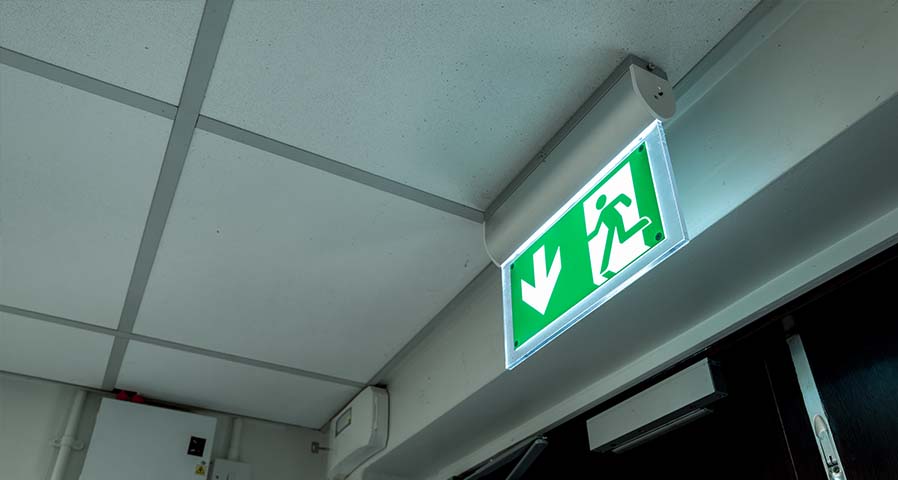
Emergency lighting systems protect building occupants when a fire, electrical failure, severe weather event, or utility outage interrupts normal lighting. They automatically illuminate designated exit routes so occupants can identify hazards, navigate stairways, locate exit doors, and move safely out of the building.
For facility managers, property owners, building engineers, and safety professionals, emergency lighting compliance can be difficult to manage because the requirements are spread across several codes and standards. The National Fire Protection Association (NFPA), National Electrical Code (NEC), International Building Code (IBC), and locally adopted regulations may all affect where emergency lighting is required, how the system receives power, how much illumination it must provide, and how often it must be tested.
This guide explains the primary emergency lighting requirements for commercial buildings without requiring facility teams to interpret multiple code documents on their own.
The following table summarizes the core performance requirements that apply to many commercial emergency lighting systems.
| Requirement | Code-Based Standard |
| System activation | Automatic upon loss of normal power |
| Emergency power availability | Within 10 seconds for applicable emergency systems |
| Minimum operating duration | At least 90 minutes |
| Initial egress illumination | Average of at least 1 foot-candle at floor level |
| Minimum initial illumination | At least 0.1 foot-candle at any point along the egress path |
| End-of-duration average | At least 0.6 foot-candle after 90 minutes |
| Monthly testing | Functional test lasting at least 30 seconds |
| Annual testing | Full 90-minute operational test |
The IBC requires emergency lighting to provide an initial average illumination of at least 1 foot-candle, with no point falling below 0.1 foot-candle along the path of egress. At the end of the required operating period, the average may decline to 0.6 foot-candle, with a minimum of 0.06 foot-candle at any point.
These figures establish a national model-code baseline. The AHJ determines which code edition and local amendments apply to a specific property.
Emergency lighting systems provide temporary illumination when normal electrical power is interrupted. Their primary purpose is to maintain visibility along the means of egress—the continuous route occupants follow from an occupied space to a safe location outside the building.
An emergency lighting system may receive backup power from:
The system must operate automatically. Occupants and building personnel should not have to locate a switch or manually transfer a circuit during an outage.
Emergency lighting is also different from optional standby lighting. Emergency lighting supports life safety and evacuation. Standby lighting supports selected business operations, equipment, security functions, or processes that a building owner wants to maintain during an outage.
Emergency lighting is not simply an inspection requirement. It protects the building, its occupants, and the organization responsible for maintaining the property.
Dark corridors, stairways, ramps, and changes in elevation create immediate slip-and-fall hazards. Effective emergency illumination reduces the risk of occupant injuries and the liability claims that can follow an incident.
Emergency lighting keeps exit routes visible when normal fixtures fail. Occupants can identify doors, stairs, obstacles, and directional markings without relying on smartphones or natural light.
Firefighters, emergency medical personnel, and other response teams need immediate visibility when entering an unfamiliar or smoke-affected building. A functioning emergency lighting system helps them navigate corridors, stairwells, equipment rooms, and exit routes more safely.
Failed batteries, blocked fixtures, inadequate illumination, and missing test records can lead to fire inspection deficiencies. A maintained system helps the facility demonstrate compliance without last-minute repairs or documentation searches.
A localized electrical failure does not always require a full facility shutdown. Reliable emergency lighting supports safe movement while facility teams investigate the problem, coordinate repairs, and determine whether occupants must evacuate.
Strengthen Electrical Safety with a Proactive Maintenance Strategy
Electrical system reliability starts with proactive maintenance. Understanding NFPA 70B is an important first step for facility managers looking to improve electrical safety, reduce unplanned downtime, and build a documented maintenance program that supports long-term operational reliability. As a formal standard for electrical equipment maintenance, NFPA 70B emphasizes preventive maintenance, routine inspections, and proper documentation to help facilities reduce risk and maintain safe electrical systems.
Read our guide to learn what NFPA 70B means for your facility, why preventive maintenance matters, and how a structured electrical maintenance program can help protect your people, equipment, and operations.
👉 Read: What Is NFPA 70B? A Guide to Electrical Safety and Reliability
No single document governs every component of commercial emergency lighting. Several codes work together to establish where lighting is required, how it must perform, and how it connects to the electrical system.
NFPA 101, also known as the Life Safety Code, addresses occupant protection and means-of-egress safety. It establishes emergency illumination requirements for exit access, exits, and exit discharge areas across multiple occupancy classifications.
NFPA 101 also establishes inspection and testing expectations. NFPA guidance calls for an annual 90-minute operating test to confirm the full capacity of battery-powered emergency lighting equipment.
NFPA 70, commonly called the National Electrical Code, establishes requirements for the safe installation of electrical wiring and equipment.
Article 700 addresses emergency systems, including:
The NEC focuses on electrical reliability and installation. It does not replace the building and life safety codes that determine where emergency illumination is required.
The International Building Code establishes building construction, occupancy, and means-of-egress requirements. The IBC applies broadly to commercial buildings and is adopted in all 50 states, although the adopted edition and local amendments vary by jurisdiction.
The IBC identifies spaces that require emergency power for egress illumination and establishes minimum illumination levels along the exit path.
NFPA 110 applies when a generator or another emergency power supply system supports emergency loads.
It addresses:
NFPA 110 becomes especially relevant in hospitals, high-rise buildings, industrial facilities, data centers, and other properties that rely on generators to support emergency lighting and additional life safety loads.
The AHJ is the official or organization responsible for interpreting and enforcing the adopted code. Depending on the project and location, the AHJ may include:
The AHJ determines which code edition applies, how local amendments affect the project, what documentation is required, and whether the installed system meets the applicable standard.
Emergency lighting is required in designated portions of the means of egress and in other spaces identified by the adopted building and life safety codes.
Rather than treating every room the same, the code focuses on the routes and spaces occupants must use during evacuation.
Emergency illumination applies to the continuous exit route, including:
These areas form the primary path occupants use to reach a safe location.
Emergency lighting may also be required in:
Requirements depend on the occupancy classification, occupant load, room configuration, and adopted code.
Additional coverage may apply to:
These spaces may need emergency illumination because employees or emergency personnel must access equipment during a power failure.
| Building Area | Emergency Lighting Application |
| Exit corridors | Required along designated egress routes |
| Stairways and ramps | Required where they form part of the means of egress |
| Exit passageways and doors | Required to maintain a visible evacuation route |
| Exit discharge areas | Required where occupants continue toward a public way |
| Assembly areas | Required based on occupancy and egress configuration |
| Parking garages | Required in designated egress and pedestrian areas |
| Mechanical and electrical rooms | Required when identified by the applicable code |
| Individual offices | Required when the space or route meets code criteria |
| Storage rooms | Determined by size, use, layout, and egress design |
Emergency lighting does not need to be installed in every private office, closet, or storage space. It must cover the locations identified by the applicable code and the facility’s approved egress plan.
Building modifications can change those requirements. New partitions, storage racks, machinery, furniture, or locked doors may obstruct existing fixtures or alter the approved exit path.

Emergency lighting systems must remain operational for at least 90 minutes after normal power fails.
The 90-minute requirement provides time for occupants to evacuate and allows emergency personnel to move through the property. The emergency power source must support the connected lighting load for the entire period. ICC code provisions require continued emergency illumination for no less than 90 minutes following primary power loss.
Approved power sources include:
A fixture that activates during a brief monthly test but goes dark before the end of the 90-minute period does not meet the full-duration requirement.
Battery performance declines because of age, heat, cold, corrosion, repeated discharge cycles, charger failure, and poor maintenance. The annual test confirms whether the system can still support its required load.
Emergency systems governed by NEC Article 700 must restore emergency power within 10 seconds after the loss of normal power.
Self-contained battery fixtures often illuminate immediately. A generator-backed system requires time to detect the outage, start the generator, stabilize the electrical output, and transfer the emergency load.
The system must complete this process automatically. Emergency operation cannot depend on a staff member locating a switch or manually starting equipment.
Emergency lighting does not need to reproduce normal working light levels. It must provide enough illumination for occupants to recognize the egress route and move safely around hazards.
The IBC establishes the following performance levels along the path of egress:
| Measurement Point | Required Illumination |
| Initial average at floor level | At least 1 foot-candle |
| Initial minimum at any point | At least 0.1 foot-candle |
| Average after 90 minutes | At least 0.6 foot-candle |
| Minimum at any point after 90 minutes | At least 0.06 foot-candle |
These levels are measured at the walking surface.
Fixture performance depends on more than whether the lamp or LED turns on. Effective illumination is influenced by:
A fixture can operate correctly and still fail to provide adequate coverage if shelving, equipment, banners, or new walls block its light.
Large, complex, or high-risk facilities may require photometric calculations or field measurements to confirm that illumination levels meet the adopted code.
The appropriate emergency lighting system depends on the building size, occupancy, electrical infrastructure, maintenance resources, and emergency power strategy.
A self-contained unit houses the battery, charger, lamps, and transfer components within one fixture.
These fixtures are common in offices, retail stores, restaurants, schools, smaller warehouses, and multifamily common areas. They are straightforward to install, but each unit requires individual inspection and maintenance.
An LED fixture with an emergency driver or battery pack operates at a reduced light output during a power failure.
This option can preserve the appearance of the normal lighting layout while eliminating separate wall-mounted emergency heads. The fixture’s emergency-mode output—not its normal lumen output—must provide the required egress illumination.
A central battery system supplies emergency power to multiple fixtures from one location.
Central systems can simplify battery replacement, monitoring, and maintenance across large facilities. They require carefully designed emergency circuits and may involve a higher initial installation cost.
An emergency generator supplies power to designated lighting circuits and other critical loads.
Generator-backed systems are common in:
The generator, transfer switch, fuel supply, and distribution equipment must all function correctly for the emergency lighting system to operate.
Battery-backed fixtures may still be installed to provide illumination during generator startup and transfer.
A lighting inverter converts stored direct-current battery power into alternating-current power for designated lighting circuits.
Inverters allow selected normal fixtures to remain illuminated during an outage. The system must be properly sized, compatible with the connected LED drivers or other lighting equipment, and listed for emergency use.
Emergency lighting must receive monthly functional testing and annual full-duration testing.
A functional test must be completed at least once every 30 days and run for at least 30 seconds.
The test verifies that:
Self-testing emergency fixtures can automate portions of this process, but facility teams must still review status indicators, error reports, and maintenance alerts.
A full-duration test must be completed once each year and run for at least 90 minutes.
The test confirms that the battery, central system, inverter, or generator can support the required emergency lighting load for the full operating period. NFPA guidance specifies a minimum 90-minute annual operating test for battery-powered emergency lighting.
| Test Frequency | Required Duration | What the Test Confirms |
| Every 30 days | At least 30 seconds | Automatic activation and basic equipment operation |
| Once per year | At least 90 minutes | Full battery capacity and required operating duration |
Test records should include:
A functioning system without complete records may still produce an inspection deficiency because the facility cannot demonstrate that required testing occurred.
See How One Retailer Achieved 100% Life Safety Lighting Compliance
Maintaining compliant emergency lighting across hundreds of locations is no easy task. In this case study, Action Services Group partnered with a national specialty retailer to implement a standardized life safety lighting program across more than 800 stores. The result was 100% compliance, the elimination of fire marshal inspection failures, and a centralized process for testing, reporting, and maintenance management.
Read the full case study to learn how a proactive life safety lighting program can improve compliance, simplify documentation, and reduce the administrative burden of managing emergency lighting across multiple facilities. Then explore how Action Services Group’s nationwide Life Safety Lighting Services can help keep your organization safe, compliant, and inspection-ready.
👉 Read the Life Safety Lighting Case Study
Emergency lighting deficiencies often develop gradually. Equipment may remain installed and appear functional even when its battery, placement, light output, or electrical connection no longer meets the applicable requirements.
A deteriorating battery may power a fixture during a short monthly test but fail before the end of the required 90-minute period. Battery age, temperature, charging conditions, and repeated discharges all affect service life.
Storage racks, partitions, machinery, banners, decorations, and furniture can block emergency light from reaching the walking surface. Renovations may also create new dark areas along the egress route.
Failed LEDs, burned-out lamps, dirty lenses, damaged housings, defective chargers, and deteriorated drivers can reduce emergency output or prevent the fixture from operating.
Emergency fixtures may be connected to a switched circuit, the wrong branch circuit, or a backup power source that does not transfer correctly. Generator-backed systems can also fail when maintenance, fuel management, or transfer-switch testing is neglected.
Missed monthly tests, incomplete annual tests, and undocumented repairs make it difficult to demonstrate compliance. Testing records should remain organized, accessible, and tied to specific equipment locations.
Facility managers can reduce failures and inspection deficiencies by including emergency lighting in a structured preventive maintenance program.
Assign a unique identifier to every emergency fixture, battery pack, inverter, generator, and transfer switch. Record the equipment location, model, installation date, battery age, test history, and repair history.
Schedule monthly and annual tests in advance. Use computerized maintenance management software, a spreadsheet, or a standardized inspection log to track results and corrective actions.
Track battery age and replace batteries, lamps, drivers, chargers, and damaged fixtures before they fail. Facilities exposed to extreme heat or cold should account for accelerated battery degradation.
Review emergency lighting whenever walls, doors, workstations, storage racks, machinery, or exit routes change. A fixture layout designed for the original floor plan may not provide adequate illumination after a renovation.
Qualified professionals can evaluate fixture spacing, emergency-mode output, circuit connections, transfer equipment, backup power sources, and code compliance. A professional assessment is especially valuable before an inspection, during a renovation, or when upgrading an aging system.
How long must emergency lighting stay on during a power outage?
Emergency lighting must remain operational for at least 90 minutes after the loss of normal power.
What code governs emergency lighting?
NFPA 101 governs life safety and egress performance, NFPA 70 governs electrical installation, the IBC establishes building and occupancy requirements, and NFPA 110 applies to generator-backed emergency power systems. The AHJ enforces the codes adopted in the local jurisdiction.
How often does emergency lighting need to be tested?
Emergency lighting must receive a functional test every 30 days for at least 30 seconds and a full 90-minute operational test once each year.
Where is emergency lighting required in a building?
Emergency lighting is required along designated means-of-egress routes, including exit corridors, stairways, ramps, exit passageways, exit doors, and discharge areas. Additional spaces depend on occupancy, occupant load, building configuration, and locally adopted codes.
Does every room in a commercial building need emergency lighting?
No. Emergency lighting applies to required egress routes and other spaces identified by the adopted code. The approved building layout, occupancy classification, and AHJ interpretation determine the final locations.
Are exit signs and emergency lighting the same system?
No. Exit signs identify the location and direction of exits, while emergency lighting illuminates the path occupants use to reach those exits. Commercial buildings often require both.
Emergency lighting is one of the most critical life safety systems in a commercial building. A compliant system must do more than activate during a brief push-button test—it must turn on automatically, illuminate the required means of egress, maintain code-compliant light levels, operate for at least 90 minutes, and undergo routine inspection, testing, and maintenance.
Whether you’re upgrading aging emergency lighting, preparing for a fire or safety inspection, renovating a facility, or developing a preventive maintenance program, staying ahead of code requirements helps protect occupants, reduce liability, and ensure your building is ready when an emergency occurs.
Action Services Group helps commercial organizations maintain safe, reliable, and code-compliant facilities through comprehensive electrical and lighting services. From emergency lighting upgrades and repairs to inspections, preventative maintenance, and turnkey electrical solutions, our experienced team can help you keep your emergency lighting systems operating properly and ready when they matter most. Contact Action Services Group to learn how we can support your facility’s life safety and compliance goals. Contact our experts by calling 610-558-9773, email [email protected], or schedule a call directly through our website.

When retrofitting your LEDs, lightbulbs have various illuminance. Theres different ways to measure the lighting of…

Understanding light measurements, luminance and foot-candle can help when choosing the perfect bulb for you next…

Exit signs and emergency lighting need to be in accordance with the NFPA, OSHA, and other…
When retrofitting your LEDs, lightbulbs have various illuminance. Theres different ways to measure the lighting of your next retrofit.
Understanding light measurements, luminance and foot-candle can help when choosing the perfect bulb for you next retrofit.
Exit signs and emergency lighting need to be in accordance with the NFPA, OSHA, and other state or local ordinances.