

What Are the Requirements for Exit Signs and Emergency Lighting?
Exit signs and emergency lighting need to be in accordance with the NFPA, OSHA, and other…

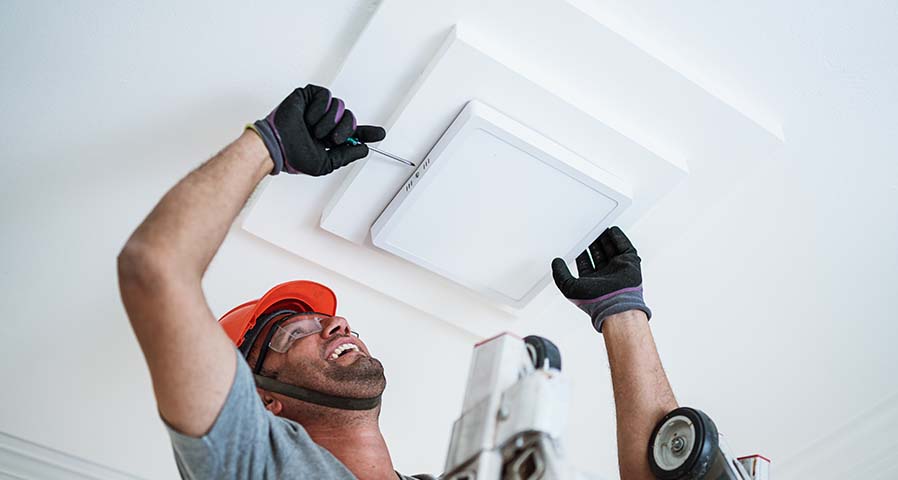
Choosing between an LED Upgrade and an LED Retrofit is one of the most common decisions facility managers face when modernizing commercial lighting. Both paths move a building toward greater efficiency, lower maintenance, and improved light quality, but they take different approaches to achieve them. Understanding the practical differences helps organizations select the option that delivers the strongest return.
LED Upgrade: removing the old light fixture and installing a brand-new fixture designed for LED technology.
LED Retrofit: keeping the light fixture you already have and replacing only the internal parts with LED components instead of replacing the whole unit.
An LED retrofit focuses on improving the equipment that is already in place. The existing housing and structure remain, while the light source and electrical components are replaced with LED technology. This method is most effective when fixtures are still in good physical condition, and the priority is a fast, cost-efficient upgrade.
Typical retrofit approaches include:
The main advantage of an LED retrofit is speed. Installation is usually faster, material costs are lower, and operations can continue with little interruption. However, performance is still influenced by the age of the original fixture and wiring.

An upgrade delivers an entirely new lighting platform rather than modifying the old one. The existing fixture is removed and replaced with a luminaire engineered specifically for LED optics, heat management, and modern electrical standards. This route is typically chosen when current fixtures are outdated, damaged, or unable to meet present lighting requirements.
A full upgrade typically includes:
Because everything is new, this path delivers the highest efficiency and longest service life. It also opens the door to advanced strategies such as dimming, scheduling, daylight harvesting, and occupancy response.
The choice is not simply about cost. It is about performance, longevity, and future flexibility. The table below summarizes the most common distinctions seen in commercial projects.
| Category | LED Lighting | Fluorescent Lighting |
| Lifespan | 50,000–100,000+ hours | 15,000–30,000 hours |
| Energy Use | 130+ lumens per watt | 50–100 lumens per watt |
| Maintenance | 10+ years | 3–5 years |
| Environmental Impact | Mercury-free | Contains mercury |
| Light Performance | Instant-on with stable output | Warm-up time and possible flicker |
| Heat and Directionality | Directional with minimal light loss | Omnidirectional with reflector losses |
Retrofits are attractive for quick payback and phased projects. Upgrades make more sense when a facility wants a long-term platform rather than a short-term fix.
Both paths reduce consumption dramatically compared with legacy lighting, yet new fixtures usually achieve greater gains. Integrated luminaires are engineered for LED performance with better heat dissipation and optical control. Many projects also combine upgrades with sensors and schedules that cut usage beyond the lamp level.
Retrofits still deliver meaningful reductions, often lowering lighting energy by 50 to 70 percent, depending on the technology replaced. For spaces with relatively new, well-maintained fixtures, a retrofit can capture most of the savings at a lower investment.
Upgrade or Retrofit – Get the Right Solution
Whether your project calls for a full LED upgrade or a targeted retrofit, the key is choosing the approach that aligns with your facility, budget, and long-term goals. Visit our LED Retrofit Solutions page to see how Action Services Group delivers customized, turn-key LED lighting solutions across a wide range of commercial and industrial applications.
When you’re ready, schedule a call with our lighting experts to review your existing system and determine the best path forward.
👉 Explore LED Retrofit Solutions
👉 Schedule a Call with a Lighting Expert
Maintenance costs are a hidden driver of the LED upgrade vs LED retrofit decision. Retrofitted fixtures may retain aging sockets, lenses, and wiring. While the LED components last longer than traditional sources, the surrounding hardware can limit overall reliability.
New LED fixtures remove those variables. With fewer parts such as ballasts and starters, service calls decline, and access to hard-to-reach areas becomes less frequent. For warehouses, distribution centers, and exterior locations, the reduction in lift rentals and labor can outweigh the higher initial price.
Lighting quality and controls improve most significantly with a full LED upgrade. Modern LED fixtures are engineered with purpose-built optics that distribute light more evenly across work surfaces, reducing glare, dark spots, and flicker that are common with older systems. Integrated luminaires also allow precise selection of color temperature and output levels, creating a more comfortable and productive environment.
An LED retrofit can still deliver meaningful improvements, especially in brightness and efficiency, but the results are influenced by the original reflector, lens, and fixture design. Because the outer housing remains, light distribution may not achieve the same level of uniformity as a new fixture can.
Control represents another major difference between the two approaches. New LED fixtures are typically designed to work seamlessly with modern building strategies, such as:
Retrofit solutions can support some of these features, yet compatibility is often more limited and may require additional components or custom wiring. For facilities focused on automation, energy management, and long-term flexibility, an LED Upgrade provides the most comprehensive foundation, while a retrofit is a practical step toward improved performance.
Choose an LED Retrofit when:
Choose an LED upgrade when:
Many organizations adopt a hybrid strategy, retrofitting offices and back-of-house areas while upgrading high-bay, exterior, and customer-facing spaces.

Utility programs increasingly reward comprehensive improvements. Some incentives cover retrofit kits, while others offer higher tiers for new DLC-listed fixtures and controls. The financial outcome can change significantly once rebates, tax benefits, and maintenance savings are considered. Evaluating incentives early prevents valuable funding from going to waste.
Every facility is different, and the best path is rarely one-size-fits-all. Action Services Group helps organizations compare LED upgrade and LED retrofit options using site audits, photometric planning, and life-cycle cost analysis. Our team evaluates existing infrastructure, operational goals, and control opportunities to recommend the solution with the strongest return.
We also manage rebate recovery from start to finish, identifying eligible programs, preparing documentation, and securing incentive payments that reduce project costs. Whether the answer is a targeted retrofit, a full upgrade, or a blended approach, Action Services Group ensures the transition to LED technology delivers measurable energy savings, improved light quality, and long-term reliability. Contact Action Services Group at 610-558-9773, email [email protected], or schedule a consultation.
Exit signs and emergency lighting need to be in accordance with the NFPA, OSHA, and other…

Action Services Group has acquired Stouch Lighting to advance national LED upgrades, turnkey lighting solutions, LED…
Outsourcing lighting upgrades and maintenance needs improves tenant retention and boosts ROI for property managers.
Exit signs and emergency lighting need to be in accordance with the NFPA, OSHA, and other state or local ordinances.
Action Services Group has acquired Stouch Lighting to advance national LED upgrades, turnkey lighting solutions, LED retrofit services and lighting…
Outsourcing lighting upgrades and maintenance needs improves tenant retention and boosts ROI for property managers.