

Lighting Measurements – An In-depth Guide Part 1
When retrofitting your LEDs, lightbulbs have various illuminance. Theres different ways to measure the lighting of…

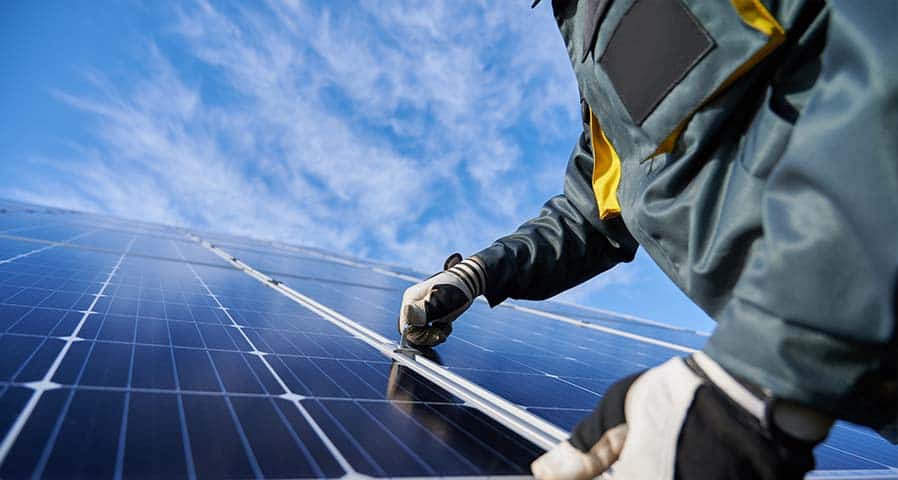
New solar panel technology in 2026 is expanding opportunities for commercial properties to generate more electricity from limited space. Higher-efficiency silicon panels, bifacial designs, and emerging tandem cells are advancing solar production, while battery storage and intelligent controls help buildings manage that electricity.
According to Fraunhofer ISE, commercial silicon module efficiencies have advanced from approximately 17% to just under 25% over the past decade. For commercial property owners, that progress can support greater generating capacity where rooftop equipment, shading, and access requirements restrict installation space.
Solar panel efficiency is improving through cell designs that reduce electrical losses and convert more incoming sunlight into electricity.
Tunnel oxide passivated contact, or TOPCon, uses specialized layers and contacts to reduce losses within silicon cells. Heterojunction, or HJT, combines crystalline silicon with thin silicon layers. Back-contact designs move electrical contacts behind the cell, reducing shading on its front surface.
For commercial properties, these improvements matter most when usable installation space is constrained. However, buyers need to distinguish three measurements:
| Measurement | What It Tells You | How to Use It |
| Cell efficiency | Conversion efficiency of an individual solar cell | Evaluate technology development |
| Panel efficiency | Conversion efficiency of the complete module | Compare products within available space |
| Annual energy production | Electricity generated over a year, measured in kWh | Evaluate expected building-level performance |
High laboratory cell efficiency does not determine a finished panel’s performance. Likewise, a higher panel rating does not eliminate losses from shading, elevated temperatures, or inverter operation.
Standard Test Conditions use an irradiance of 1,000 watts per square meter, a cell temperature of 25°C, and an AM1.5 reference solar spectrum. These controlled conditions provide a consistent basis for comparing rated output.
The IEC 60904 series establishes photovoltaic measurement procedures and reference conditions. Actual commercial rooftops experience changing sunlight, temperatures, and shading, so pair rated power with site-specific energy modeling.
At those test conditions, a panel rated at 23% efficiency converts 23% of the incident solar energy into electrical output. That figure does not predict that the building’s electricity bill will fall by 23%.
Bifacial solar panels generate electricity from light reaching both their front and rear surfaces. Traditional monofacial panels primarily collect light from the front.
The additional production depends on reflected sunlight. Mounting height, row spacing, surface reflectivity, and nearby obstructions determine how much light reaches the rear. The IEA Photovoltaic Power Systems Program identifies installation conditions as central to bifacial performance.
Commercial applications can include elevated rooftop arrays, parking canopies, and ground-mounted systems. Panels positioned close to a dark roof may receive little rear-side benefit.
Rather than applying a universal production increase, project teams should request an energy model that accounts for the proposed mounting configuration and surface conditions.
Perovskite solar cells use a light-absorbing material with a particular crystal structure. Combining that material with silicon creates a tandem cell whose layers capture different portions of the solar spectrum.
According to the U.S. Department of Energy, laboratory perovskite-silicon tandem cells have exceeded 33% efficiency. These results demonstrate technological potential, not the expected efficiency of commercially available rooftop panels.
Durability, manufacturing consistency, and performance at full panel scale remain central development challenges. Commercial buyers should verify product availability, independent testing, warranties, and operating history before specifying tandem panels.
Battery storage shifts electricity from when it is generated to when it is needed. A facility can store surplus midday production for later use, depending on battery capacity and operating requirements.
Storage does not increase panel conversion efficiency and charging and discharging involve losses. Its benefits come from improving the timing of electricity use. The U.S. Department of Energy distinguishes this flexibility from electricity generation itself.
AI-supported forecasting and monitoring can help coordinate battery operation, flexible loads, and maintenance investigations. Effective operation still requires accurate data, compatible equipment, and properly commissioned controls.
Does IEC qualification guarantee a 25-year panel lifespan?
No. IEC 61215 addresses module design qualification, but its test results do not quantitatively predict service life. Evaluate warranties and operating conditions separately.
Do higher-wattage panels always have higher efficiency?
No. A larger panel may produce more watts because it has more surface area. Compare dimensions and efficiency together.
Does solar reduce a building’s underlying electricity consumption?
No. Solar supplies electricity. Lighting upgrades, HVAC improvements, and operating controls reduce the electricity the building needs.
Evaluate commercial solar technology trends against usable space, roof condition, and hourly electricity demand. Request comparable test ratings, realistic annual production estimates, and documented equipment qualifications. These benchmarks help property owners select improvements that support measurable energy goals while distinguishing proven products from emerging research.
Read the full article on Spectrum Energy Systems.

When retrofitting your LEDs, lightbulbs have various illuminance. Theres different ways to measure the lighting of…
Understanding light measurements, luminance and foot-candle can help when choosing the perfect bulb for you next…

Exit signs and emergency lighting need to be in accordance with the NFPA, OSHA, and other…
When retrofitting your LEDs, lightbulbs have various illuminance. Theres different ways to measure the lighting of your next retrofit.
Understanding light measurements, luminance and foot-candle can help when choosing the perfect bulb for you next retrofit.
Exit signs and emergency lighting need to be in accordance with the NFPA, OSHA, and other state or local ordinances.