

Lighting Measurements – An In-depth Guide Part 1
When retrofitting your LEDs, lightbulbs have various illuminance. Theres different ways to measure the lighting of…


Luminaire-Level Lighting Controls (LLLC) are changing how commercial buildings manage lighting, energy efficiency, and occupant comfort. Instead of relying on centralized lighting zones, LLLC systems allow every fixture to function as an intelligent control point with integrated sensors, dimming, and networking capabilities.
Why are luminaire-level lighting controls becoming a major priority in commercial buildings?
Luminaire-Level Lighting Controls (LLLC) are advanced lighting control systems that integrate sensors, controllers, and communication technology directly into each light fixture. Instead of controlling multiple fixtures from a single wall sensor, every luminaire becomes its own intelligent control point.
LLLC lighting controls typically include:
This creates a one-to-one control relationship between the fixture and the control system, unlike traditional networked lighting controls that typically use a one-to-many approach.
In modern commercial buildings, LLLC systems are commonly deployed in:
LLLC systems combine LED lighting, embedded controls, sensors, and wireless networking into a unified platform. Each luminaire communicates with nearby fixtures, gateways, and software platforms to automatically adjust lighting conditions throughout the building.
A typical luminaire-level lighting control system includes:
| Component | Function |
| Occupancy Sensors | Detect motion and occupancy patterns |
| Daylight Sensors | Measure available natural light |
| LED Driver | Controls dimming and power delivery |
| Gateway or Hub | Connects fixtures to the network |
| Configuration Software | Programs scenes, schedules, and zones |
| Wall Stations | Allows occupant overrides and scene selection |
Modern systems often use communication protocols such as DALI, Bluetooth, Zigbee, RF wireless, Power over Ethernet (PoE), or proprietary wireless platforms.
Because the controls are factory-installed within the luminaire, compatibility issues are reduced, and installation becomes significantly simpler.
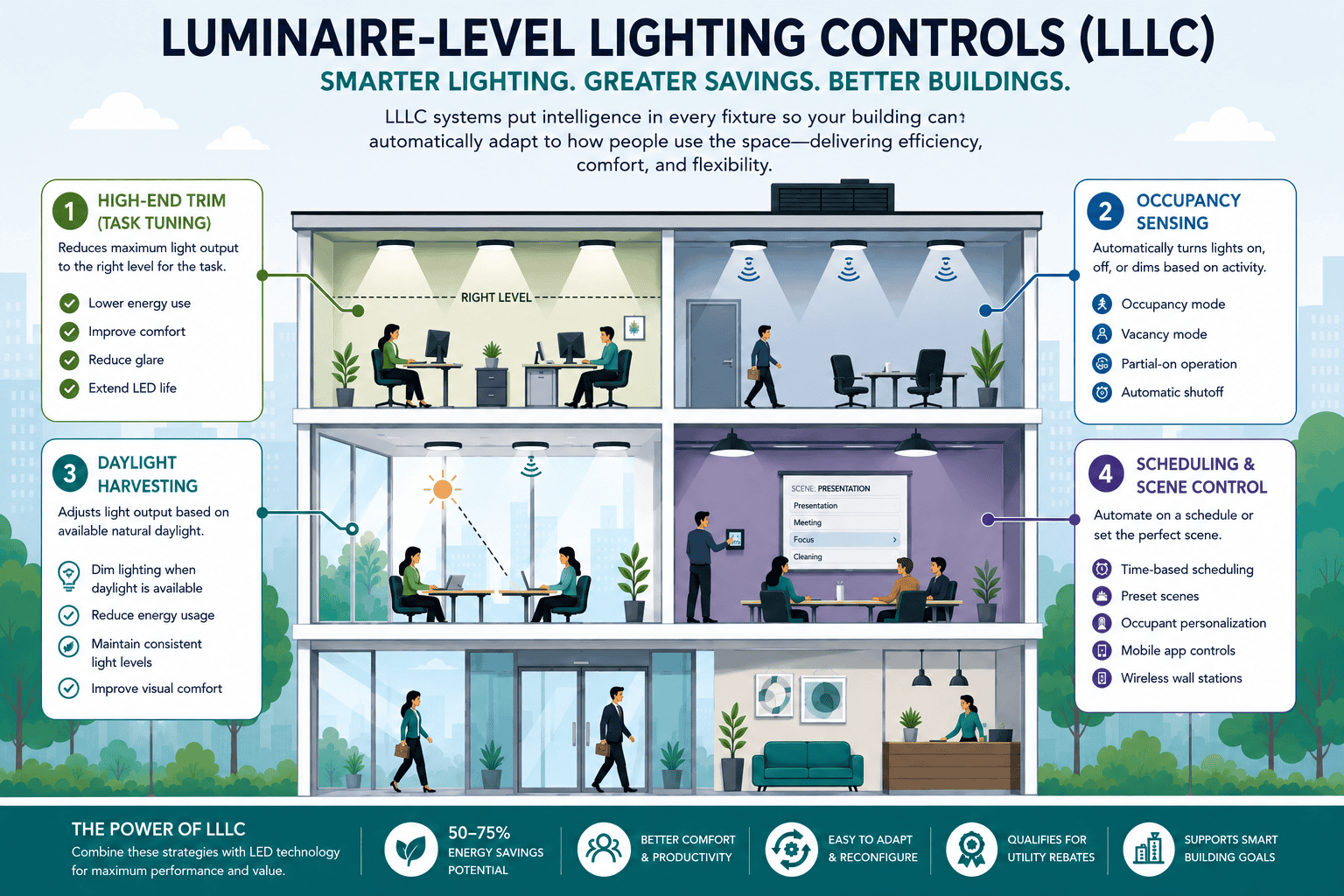
LLLC lighting controls use multiple automated control strategies to optimize energy savings and lighting quality. The most common strategies include:
High-end trim reduces maximum light output to the appropriate target level during commissioning. Many commercial spaces are initially overlit, wasting energy and causing visual discomfort.
Occupancy sensing automatically turns fixtures on, off, or dimmed based on room activity.
LLLC occupancy controls support:
Because each fixture has its own sensor, the system provides much finer control granularity than centralized systems.
Daylight harvesting uses photosensors to adjust fixture output based on available natural daylight continuously.
Commercial buildings with perimeter windows, skylights, or atriums can significantly reduce energy usage by dimming luminaires when daylight levels rise.
Many LLLC systems support:
Facility managers can quickly reconfigure lighting layouts without rewiring the building.

One of the biggest advantages of luminaire-level lighting controls is energy reduction. According to the 2020 Northwest Energy Efficiency Alliance (NEEA) LLLC Study, advanced LLLC systems achieved 50–74% energy savings from controls alone, excluding the LED upgrade itself. The same study found that average energy savings from LLLC deployments often exceed 60%.
Some advanced systems achieve even higher savings when combining:
Traditional lighting control systems often require extensive control wiring, ceiling-mounted sensors, and centralized panels.
LLLC simplifies installation because:
This is especially valuable in retrofit projects where minimizing disruption is critical.
Commercial spaces constantly evolve due to tenant turnover, renovations, and workspace redesigns.
With LLLC systems:
This flexibility makes LLLC ideal for dynamic office environments.
LLLC lighting systems improve the occupant experience by delivering lighting that adapts to real-world building usage.
Benefits include:
Well-designed controls also minimize distracting lighting changes through smooth dimming transitions and properly configured fade rates.
Modern luminaire-level lighting control systems often function as part of a larger smart building ecosystem.
Advanced platforms can integrate with:
Some systems also support indoor positioning and occupancy heat mapping via Bluetooth and Wi-Fi.
| Feature | Traditional NLC | LLLC Lighting Controls |
| Control Relationship | One sensor controls multiple fixtures | Each fixture has independent control |
| Sensors | Ceiling-mounted remote sensors | Embedded within luminaires |
| Wiring Complexity | Higher | Lower |
| Zoning Flexibility | Moderate | Extremely high |
| Reconfiguration | Often requires rewiring | Software-based changes |
| Granularity | Group-level | Fixture-level |
| Installation Speed | Moderate | Faster |
| Data Collection | Limited | Highly detailed |
LLLC systems are a more granular and intelligent version of networked lighting controls.
Many utility rebate programs now specifically incentivize luminaire-level lighting control systems because they deliver measurable energy savings and support modern energy codes.
LLLC systems can help buildings comply with:
Many rebate programs also require products listed by the DesignLights Consortium (DLC) Qualified Products List (QPL) to qualify for enhanced financial incentives.
For commercial buildings pursuing ENERGY STAR certification, LEED goals, or Environmental, Social, and Governance (ESG) initiatives, LLLC systems support long-term sustainability objectives while lowering operating costs.
Maximize Rebates for Your Lighting Controls Project
Lighting controls often qualify for some of the highest commercial energy rebates available, but managing utility requirements and applications can be time-consuming. Incentive Rebate360, an affiliate of Action Services Group, helps businesses identify and secure rebates for networked lighting controls, LLLC systems, occupancy sensing, daylight harvesting, and other advanced control strategies.
Our team simplifies the rebate process to help reduce upfront project costs and improve ROI.
👉 Explore Rebate Recovery Services
👉 Schedule a Call with Our Experts
Despite their advantages, LLLC systems are not ideal for every application.
Potential challenges include:
However, declining equipment costs and increasing rebate availability continue to improve ROI for commercial projects. According to the NEEA Incremental Cost Study, average LLLC costs declined significantly between 2017 and 2020, improving affordability for commercial upgrades and new construction projects.
What is the difference between LLLC and traditional lighting controls?
Traditional lighting controls typically use a single sensor to manage multiple fixtures, while LLLC systems assign each luminaire its own embedded sensor and control logic. This creates more precise lighting control and greater flexibility.
How much energy can LLLC lighting controls save?
Many commercial buildings achieve 50–75% lighting energy savings when combining LED fixtures with occupancy sensing, daylight harvesting, and scheduling strategies. Savings vary based on operating hours and building usage.
Are luminaire-level lighting control systems wireless?
Many LLLC systems use wireless communication technologies such as Bluetooth, Zigbee, or RF networking. Some systems also support wired communication through DALI or Power over Ethernet (PoE).
Do utility rebates cover LLLC lighting controls?
Yes. Many utility companies offer rebates for luminaire-level lighting control systems, especially when the products meet DesignLights Consortium (DLC) qualification requirements.
Luminaire-Level Lighting Controls are redefining commercial lighting by transforming every fixture into an intelligent, connected control point. LLLC lighting controls improve energy efficiency, simplify facility operations, support smart building integration, and create adaptable lighting environments for modern commercial spaces.
As energy codes tighten and building owners prioritize operational efficiency, luminaire-level lighting control systems are becoming a core component of high-performance commercial buildings. Facilities that combine LEDs with advanced LLLC strategies position themselves for lower operating costs, stronger sustainability performance, improved occupant comfort, and greater long-term flexibility. Contact Action Services Group today to schedule a consultation and start optimizing your lighting strategy. Call 610-558-9773 or email [email protected] or schedule a call.

When retrofitting your LEDs, lightbulbs have various illuminance. Theres different ways to measure the lighting of…

Understanding light measurements, luminance and foot-candle can help when choosing the perfect bulb for you next…

Exit signs and emergency lighting need to be in accordance with the NFPA, OSHA, and other…
When retrofitting your LEDs, lightbulbs have various illuminance. Theres different ways to measure the lighting of your next retrofit.
Understanding light measurements, luminance and foot-candle can help when choosing the perfect bulb for you next retrofit.
Exit signs and emergency lighting need to be in accordance with the NFPA, OSHA, and other state or local ordinances.
One Response