

Lighting Measurements – An In-depth Guide Part 1
When retrofitting your LEDs, lightbulbs have various illuminance. Theres different ways to measure the lighting of…

This blog was originally published March 20, 2020, and was updated February 19, 2026.
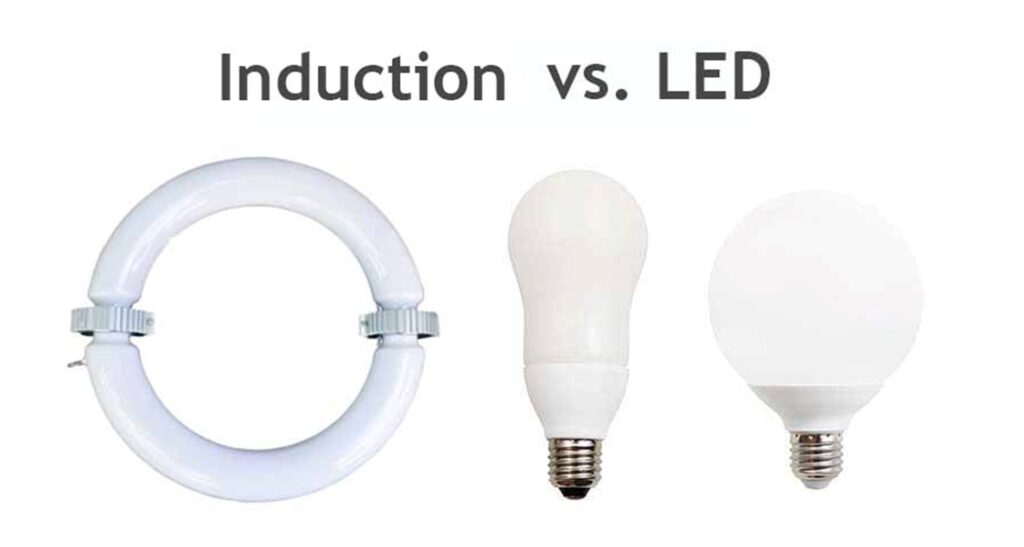
Selecting lighting for a commercial or industrial facility now involves more than checking a fixture label for wattage. Building owners evaluate delivered light, optical control, maintenance access, rebate eligibility, and long-term operating cost. The comparison between induction lighting and LED has changed as LED matured into the primary platform for modern facilities. This guide reviews how both technologies function today and what the differences mean in real buildings.
Induction lighting evolved from fluorescent technology. An external electromagnet excites a gas mixture inside the lamp, producing ultraviolet energy that a phosphor coating converts to visible light. With no internal electrodes, the design promised long life and was widely used in tunnels, transit platforms, stairwells, and other difficult locations.
The technology produced dependable, broad illumination, but it offered limited control over beam direction and relied on reflectors to shape the output. As lighting standards advanced, that lack of precision became a disadvantage.
LED fixtures are solid-state devices. An electrical current passes through a semiconductor and releases energy as photons. Because there is no gas or filament, LED tolerates vibration, cold temperatures, and frequent switching better than legacy sources.
Modern LED platforms include precision optics, multiple color temperatures, and integrated controls that direct light exactly where it is needed. These features enable the same technology to serve warehouses, offices, parking lots, healthcare facilities, educational spaces, and industrial spaces.
Watts no longer describe brightness. Lumens per watt and delivered footcandles determine actual performance.
Because LED controls the beam, retrofits frequently increase measured light levels even when fixture wattage drops by more than half. Glare is reduced, and uniformity improves, which supports safety cameras and visual tasks.
| FEATURE | INDUCTION LIGHTING | MODERN LED SYSTEMS |
| LUMINOUS EFFICACY | 85–95 Lumens/Watt | 140–170+ Lumens/Watt |
| LIGHT DISTRIBUTION | 360° (Omnidirectional) | Directional (Precision Optics) |
| OPTICAL EFFICIENCY | Low (Relies on Reflectors) | High (Engineered Lenses) |
| STANDARD CRI | ~80 | 70 to 90+ |
| DIMMABILITY | Limited / Non-standard | Standard (0-10V / Networked) |
| ENERGY REDUCTION | Baseline (vs. HID) | 30–50% Better than Induction |
Induction once delivered meaningful savings over metal halide and high-pressure sodium, usually 40–50 percent. LEDs now regularly reduce energy use by 60–80 percent when paired with controls such as occupancy sensors, daylight harvesting, and scheduling. Utility incentive programs across North America increasingly reference ENERGY STAR performance criteria and qualified product lists when determining lighting rebate eligibility. Projects that depend on incentives to reach target payback typically require ENERGY STAR–aligned LED luminaires and controls to qualify.
Induction lamps were marketed for around 100,000 hours, but drivers, ballasts, and heat often shortened real service life. As manufacturers left the market, sourcing replacement parts became difficult.
LED platforms now offer field-replaceable modules, instant-on operation, and L70 ratings ranging from 50,000 to more than 200,000 hours, thanks to modern thermal design. Facilities that chose induction to avoid relamping can achieve equal or better reliability with LED while gaining efficiency and controls.
Modern LED optics place light where it is needed, rather than scattering it in all directions like induction systems. Better uniformity reduces dark areas between fixtures and lowers glare along walkways and drive lanes. Higher color rendering improves camera clarity and helps staff more easily recognize vehicles, signage, and hazards. LEDs also produce less radiant heat and turn on instantly in cold weather, supporting reliable illumination outdoors. Directional design limits uplight and light trespass, helping facilities align with IES guidance and dark-sky objectives while maintaining safer, more comfortable environments.
Modernize Induction Lighting with a Smarter Upgrade
Induction lighting systems were once viewed as a maintenance-friendly alternative, but many now fall short of today’s energy efficiency and lighting performance standards. Learn how Action Services Group’s LED Retrofit Solutions replace aging induction fixtures with high-efficiency technology that improves visibility, lowers operating costs, and supports long-term facility performance.
Then, review our Rebate Recovery Services to see how we manage available utility incentive programs from eligibility review through final payout. Schedule a call to discuss your upgrade options and potential savings.
👉 LED Retrofit Solutions
👉 Rebate Recovery Services
👉 Schedule a Strategy Call
Action Services Group completed a multi-site exterior LED retrofit for a national entertainment company, including a facility in San Antonio, Texas, where 5,598 high-wattage fixtures were replaced with energy-efficient LED systems. The upgrade reduced annual energy use by 70 percent, cutting consumption from 78,840 kWh to 23,652 kWh and saving $4,856 in annual electricity costs. Lower maintenance needs and turnkey rebate recovery helped the project achieve a 20-month payback period while improving lighting uniformity and visibility across the parking areas.
Induction remains in older tunnels, transit facilities, and parking structures installed before LED matured. These systems often lack dimming capability and do not meet current lighting standards. Many properties maintain them only until capital budgets allow full conversion.
LEDs lead the total cost of ownership with higher efficacy, precise optical control, compatibility with networked systems, and broad rebate support. Project teams can select the color temperature, beam pattern, and control strategy for each space, rather than accepting a one-size-fits-all solution.
These approaches are generally unavailable with induction platforms.
Facilities operating induction lighting have a clear opportunity. Replacing induction with LED typically cuts energy by another 30–50 percent while improving light levels and enabling controls. A professional lighting audit compares existing conditions, confirms IES targets, and identifies projects that qualify for utility rebates.

Is induction lighting better than LED?
Induction was valued for long life, but LED now outperforms it in efficiency, light control, color quality, and smart system compatibility.
Can LED replace induction fixtures directly?
Yes. Most induction fixtures can be replaced with LED luminaires or retrofit kits that reuse mounting locations while delivering higher light levels at lower wattage.
Does LED save more energy than induction?
In most facilities, LED reduces energy use by 30–50 percent compared to induction, and even more with controls.
Which lasts longer?
Induction was promoted at 100,000 hours, but real performance varied. Quality LED fixtures now offer ratings comparable to or longer than those of replaceable components.
Are rebates available?
Most current programs prioritize LED because of controllability and higher efficacy, while induction rarely meets new incentive requirements.
Moving from induction lighting to LED is now a practical step toward lower operating costs, better visibility, and modern controls. LED provides advantages in efficiency, optical performance, safety, and long-term serviceability that legacy induction systems cannot match. If your facility is still operating induction fixtures, Action Services Group can evaluate upgrade options, confirm rebate eligibility, and deliver a turnkey LED solution aligned with your budget and performance goals. Contact Action Services Group at 610-558-9773, email [email protected], or schedule a consultation.
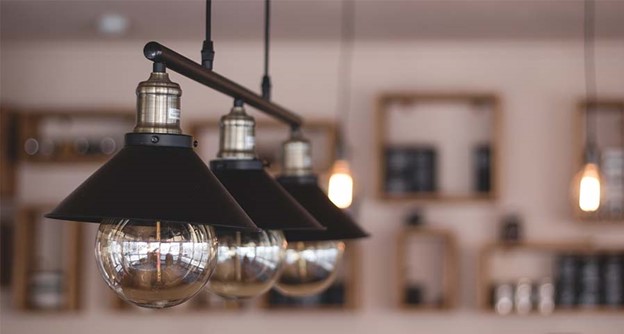
When retrofitting your LEDs, lightbulbs have various illuminance. Theres different ways to measure the lighting of…
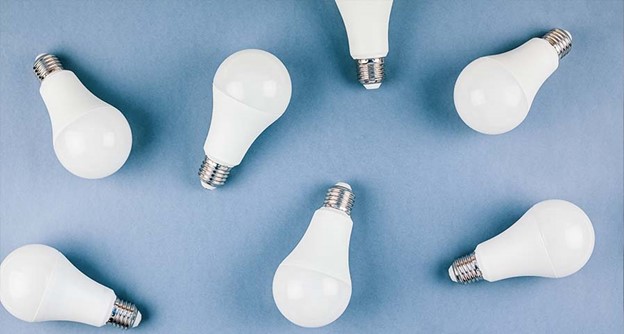
Understanding light measurements, luminance and foot-candle can help when choosing the perfect bulb for you next…
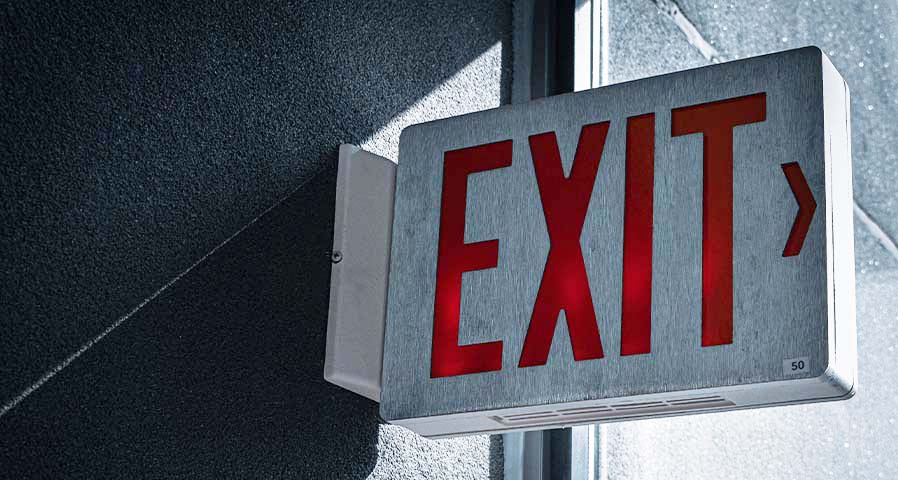
Exit signs and emergency lighting need to be in accordance with the NFPA, OSHA, and other…
When retrofitting your LEDs, lightbulbs have various illuminance. Theres different ways to measure the lighting of your next retrofit.
Understanding light measurements, luminance and foot-candle can help when choosing the perfect bulb for you next retrofit.
Exit signs and emergency lighting need to be in accordance with the NFPA, OSHA, and other state or local ordinances.